显示标签为“LED lights”的博文。显示所有博文

2015年4月29日星期三

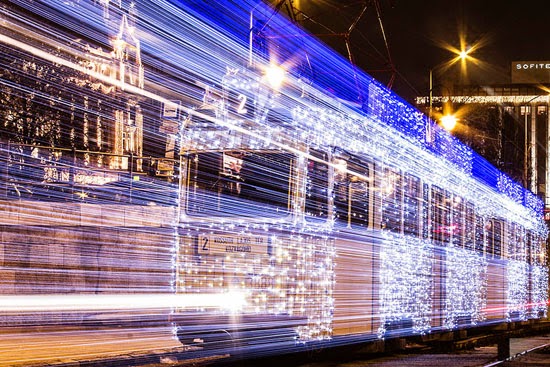
30000 twinkling LED lights make Budapest trams look like awesome time machines

Most of us have been in the tram, but there are quite a lot of people who have never been in a tram decorated by twinkling LED lights. Well, this particular tram in Budapest is wrapped in no less than 30000 LED bulbs. Perhaps traveling by this tram in particular will give you a very memorable experience unlike any other.

In celebration of the Christmas spirit, ever since 2009, the Budapest Transport Company has decorated the city’s trams with over 30000 twinkling LED lights for the duration of the holiday season. As it turns out, the tram is not wrapped in so many LED bulbs. It is just in order to commemorate a big day and a huge festive event that is about to take place in Budapest, and during that time all passengers can take the trams for no extra cost.

The lights themselves might be of no interest, but with a long exposure photo, these trams transform into ethereal cosmic vessels or time-travelling public transportation vehicles, giving photographers spending their holidays in Budapest a fun opportunity to snap some cool photos.


2015年4月7日星期二

How to maintain your LED lights for your cars

Car headlights just like the eyes of the car, seeing the road ahead clearly. Especially at dark night, car headlights can guarantee the security of the driving. Hence, it becomes very important to maintain the car lights. As we all know, it is a very easy and quick work to check the burnout of the LED lights, but it will become a difficult task to give your car a comprehensive maintenance, which will improve the comfort performance of the cars. Moreover, before giving some warning from other people, many car owners don’t pay attention to whether the headlights or taillights can work normally.


Some simple methods to identify the extent of damage: If the light is not lit, it indicates that the lights have been broken. If the light is not so bright, there are three reasons to explain the situation. The first reason is that there is a layer of dust on the astigmatism glass or reflector of the lights, and you can clean it with a cloth. The second reason is that the battery charge capacity decreased, and the insufficient brightness is caused by the power shortage. The third reason is the aging wires or the wires are too small, resulting in an increase in resistance and a decrease in current supply. This situation affects the normal operation of the lights, and the overheated wires will cause a fire.


Different type of LED lights for cars have different functions. For example, if you usually drive at night, you might consider equipping high intensity LED headlights with your car. The sufficient lighting will provide a brighter and broad view to clear all obstacles on the road ahead. In addition, the color temperature of LED lights is very high, close to daylight and no UV and IR, which is a protection for driver’s eyes. As for taillights, many rear-end accidents are caused by the breakdown of taillights. Hence, it is a great choice to replace conventional lights with LED lights, and the LED taillights are brighter and instant-on. This means that when you depress the brake pedal, the LED brake lights can light much earlier than normal bulbs, so that the trailing vehicle to have more time to prepare. Fog lights, we also called spotlight, which can guarantee the driver’s visibility in bad weather. What’s more, the LED spotlights have stronger penetration and better lighting effects than conventional lights.


Different types of LED lights have different method to maintain. Cars headlights are the most important part among all the car lights. If the headlights are burnout, you can replace the similar fixtures. In addition, you have to check the headlights lenses for cracks. Even though the cracks on the surface don’t affect the performance of the illumination, but the moisture will penetrate the cracks along the fixture, which is bound to reduce the lifespan of the LED headlights. At the same time, we must align the light illumination direction, to ensure maximum safety of the driving.


Don’t modify the lights casually, and check the luminance of all the LED vehicle lights meets the requirements of normal driving regularly.

2015年3月25日星期三

Is LED the future for automotive lighting applications?

Many vehicle drivers are always upset by the insufficient light from their headlights or taillights, which will provide poor visibility on the road, making the driving more dangerous. Especially at night, the strong glare from the other vehicles coming from the opposite direction will make the drivers feel nervous and difficult to see the road ahead. Accidents often occur in this case because the drivers have some difficulty to judge the distance and see clearly the vehicles ahead. However, with LED lighting being used for automotive application, the safety on the road has greatly increased as the road ahead gets well lit by LED headlights and the drivers feel eased when driving at night.


LED lights have been produced for commercial lighting and industry lighting for a long time ago, but LED lighting for vehicle was first introduced in 2003. With the increasing LED technology and improving performance of LED lights, many customers begin to buy LED lights for vehicle over fluorescent lights and halogen lights. What’s more, many manufacturers realized that there will be a huge potential LED lights market for automotive lighting applications and have started producing the kind of lights.

Compared with all other types of automotive lights, LED lights have some very distinct advantages. Their features of longer lifespan, great performance, lower power consumption, high light output and lower heat dissipation make them become the perfect solution of automotive lighting. Slowly but steadily, LED technology will be applied on rear combination lamps, brake lights, turn signals, interior reading lights, daytime running lamps, fog lights, position and market lamps, etc. Over the year, LED lights are now being used for many vehicles, such as off-road vehicle, 4*4 vehicles, military and trucks. In the future, LED lights will be produced to be more suitable for different types of vehicles, such as bicycles, trains and emergency vehicles.


Cars manufacturers are selecting LED lighting over other types of lights due to their ease of assembly, reliability, longevity, and competitive price. They believe that LED lights will have a bright future for automotive lighting applications because they have more advantages than conventional lights. LED lighting is adaptive to different environmental and traffic-related requirements, the dynamic bending of light or adaptive front lighting systems will help the driver see the obstacles on the road clearly. Many lamps have a defect that the lights will move together with the cars, but LED lights are resistant to vibration generated by a moving vehicle. They react very quickly to be full light intensity, but standard incandescent car lights usually take a lot of time to get switched on. The most attractive feature is that car maker can have an innovative design of LED lighting and design a unique LED light depending on the vehicle models.


With the rapidly-developing lighting technologies and the introduction of new technologies, LED lighting manufacturers will produce even better comfort and homogenous light and more types of LED lights to meet a wide variety of vehicles. LED lights will have a bright future for automotive lighting application.


2015年3月24日星期二

How energy-saving is LED lights?

If we want to know how energy-saving LED lights is, we need to understand the structure and working principle of LED lights. The important part of the LED lights is the semiconductor wafer, which is solid in nature. We called the semiconductor as Light Emitting Diode, abbreviation for LED. One side of the semiconductor wafer is negative electrode, and the other side is positive electrode. When electricity is passed through the semiconductor material, the wafer will begin to release energy in the form of visible light.


When compared with fluorescent lamps and incandescent light, LED lights have a very distinct advantage in energy-saving. Fluorescent lamps emit light by phosphorous powder, but 30% of the energy is consumed in the form of heat. While the incandescent lights emit light when electricity is passed through the filament, it uses a lot of energy to produce light, but 90% of the energy is wasted as heat. The LED lights typically use about 25%-80% less energy than traditional incandescent, saving more energy and the money.


LEDs emit light in a specific direction according to different need, which will reduce the need for reflectors and diffusers that can trap light. Different fixtures are equipped to prevent the light from reflecting into undesired directions and most of the light can be fully used. The features make the LED lights more efficient for many work lights and street lights. LED lights are available in the wide range of colors and light levels you've come to expect, you can decide the color of LED lights by controlling the size of the current, such as the red, green and blue, and the white light is typically used by a mix of red, green and blue LEDs.


As is all know, the lifespan of LED lights are more than 60000 hours, while incandescent lights last for 800 to 1500 hours, and fluorescent lights last up to 10000 hours. In addition to, the traditional fluorescent lights and incandescent lights are made of glass, which are easily broken and lower lifespan need for frequent replacement. According to a research, if 250000 street lights are replaced by LED lights in a city, the lighting switch will save $70000 and nearly 248000 kilowatt-hours a year in energy, and the replacement project is expected to save $14 million a year in energy and maintenance costs. From these data we can see, LED lights are extremely energy efficient and save a lot of economic cost. What’s more, LED lights are a great lighting option for those wishing to pay less initially for their needs, providing great performance, environmental protection, lower heat dissipation and the other features.


With the rapidly increasing need of LED market and advanced LED technology, LED lights are applied widely for commercial and industrial lighting, and it also has the potential to fundamentally change the future of lighting around the world. More and more customers and dealers are shifting toward LED lighting because of the lower power consumption and high light output, but the important reason is the energy-saving, which will help people save a lot of money in energy paying. At the same time, I hope that more and more people will replace traditional lights with LED lights, reducing the burden of energy.


2015年3月11日星期三

The future of LED lights

Across the globe, many countries are shifting toward LED lighting because of its advantages of lower wattage demand, lower maintenance cost and longer lifetime it offers. Even though the initial cost of installing outdoor LED lighting can be substantial, it can save a lot of energy for us. For example, about 200,000 street lights will be replaced by LED bulbs in Denmark itself, which are likely to save municipalities 70% on their energy bills. Nowadays, we use LED lighting for household lighting and industrial lighting such as the lamps, the light for vehicle, the work light for operation.


As the more energy-efficient illumination options for consumers and industrial users, the demand of LED lighting has been increasing in these years. Many governments successfully passed a series of domestic policies that serve to not only stimulate LED lighting demand, but also to improve LED lighting mechanism. Countries with the most advanced economies such as the United State and Japan have well-established plans and programs to phase out legacy incandescent lighting. Chinese government proposed to spend 2.2 billion RMB on the promotion of CFL and LED lights, and to prohibit the sale of 100 Watt-and above incandescent light bulbs, along with those of halogen lamps whose efficiency levels fall below required standards. That shouldn't be surprising, because the global lighting account is about 25% of the total energy consumption.

LED lights are affordable for many customers and industrial users now. The prices of low-end and low-wattage LEDs that are produced in China have reduced by nearly half in the last one year. Higher-wattage LEDs that are produced in other regions of the world have also reduced by 15 to 20%.


So far, China, the largest LED lighting market in the world, do not have good reputation in other countries. Large buyers warn that the low-priced LEDs and LED lights produced by the Chinese manufacturers usually burn out after less than a year. According to industry experts, the Chinese manufacturers are still using outdated machinery and equipment, which is a major cause for low quality of LEDs and LED products. With the rise in demand, Chinese manufacturers have started ordering new equipment from western suppliers early this year, which would soon improve the quality of their products, and hence, their reliability.


LED lighting technology has been in progress all the time. Since the invention of the blue LED, professor Hiroshi Amano, Nagoya University Graduate school, was awarded the Nobel Prize On January 14th,2015. Red and green LED have been appeared for a long time, with the appearance of blue LED, we can produce a variety of colors of LED lights. Professor Amano said,” I want people around the world can afford LED lights, but the current price is still very high for them. If the production costs will be reduced to one-fifth of today, the popularity of LED lighting products will ultimately be greater than it is now. ”


2015年2月11日星期三

What are the differences between LED lights, incandescent lights and fluorescent lamps?

For decades, we have used incandescent lights to light up hallways, bedrooms and the other places. But incandescent lights have some problems. They are inefficient, wasting lots of energy. Recently, as more fluorescent lamps are used in working and public environments, they have been consistently proven to be economical. Unfortunately, fluorescent lamps contain toxic mercury that makes them difficult to be disposed of and harmful to the environments. In order to solve these problems, technicians designed a new type of lights, light-emitting diodes (LED). They have too many advantages so that many home owners and parents will consider LED lighting over fluorescent lamps and incandescent lights.

So what are the differences between LED lights, incandescent lights and fluorescent lamps? Let’s take a look to see the advantages and disadvantages about three of them.

Energy consumption
A 60-watt incandescent light bulb draws more than $300 worth of electricity per year and provides about 800 lumens of light; an equivalent fluorescent lamp uses less than 15 watts and costs only about $75 of electricity per year. LED lights are even better, drawing less than 8 watts of power, costing about $30 per year, and lasting 50,000 hours or longer.


Longer lifespan
While incandescent lights have an average lifespan of 800 to 1500 running hours, and fluorescent lamps have an average lifespan of 10000 running hours, LED lights can have an average of lifespan of 60000 running hours. This can provide substantial saving as a result of fewer replacements needing to be bought.


Product price
It is true that LED lights are more expensive initially than fluorescent lamps and incandescent lights. Incandescent lights sell in packages for only a few bucks, and fluorescent lamps will be a little more expensive than it, but LED lights sold for more than $70. This high cost barrier has become the difficulty of LED lights to replace all the other lights.

Color temperature
Incandescent lights put off typical yellowish lighting and there are lots of limitations in selecting other different lighting color. While some fluorescent tubes now use a different type of phosphorous powder to produce a warmer color, most fluorescents produce only cold blue lighting or white lighting. In order to be applied in different environment or lighting situation, LED lights can be built to light up in a variety of colors and they don’t need filters like other bulbs.

Incandescent bulb
Incandescent lights
  

Fluorescent lamps
LED lighting

Environmental impact
LED lights are environmentally friendly over fluorescent lamps and incandescent lights. According to a research, an average household using 30 incandescent bulbs for a year will create 4500 pounds of carbon dioxide emissions. In comparison, if the same household used LED lights, it would contribute just 450 pounds of carbon dioxide emissions. Fluorescent lamps must contain a small amount of mercury which is extremely hazardous to both humans and the environment. LED lights are completely safe and do not contain such poisonous materials, putting home owners and parents at ease.

Durable features
Incandescent lights and fluorescent lamps are made of delicate glass cases and thin filaments that may break due to contact or power surges. LED lights housing is made of aluminum alloy or the other metal and plastic material, they are far less fragile than both fluorescent and incandescent lights. This makes them less likely to being inoperable due to being dropped or bashed accidentally.


Heat dissipation
While fluorescent lamps emit less heat than incandescent lights, they still produce much more than LEDs. LED lights are vulnerable to high temperatures. If LED circuitry gets too hot, more current will pass through the LED chip, which will cause the LED light burn-out.

Startup performance
Standard incandescent lights operate when an electric current pass through the filament, which need some time to produces heat, and the heat produces light. Fluorescent lamps also need some time to flicker before staying on, and they don’t provide enough illumination until they have been running for a few minutes. LED lights light up as soon as an electrical current is passed through them and provide instant light and instant full illumination.


2015年2月2日星期一

The quite arrival of LED lights

According to the report of New York, the city has replaced all of its street lights with LED lights from October 23rd 2013, which would save $70000 and nearly 248000 kilowatt-hours a year in energy.


With the wide application of LED lights in recent years, many traditional fluorescent lights and incandescent light bulbs gradually withdraw from the market. Standard lights only last 6 years, but LED light has longer lifespan and even can be used for more than 20 years. The replacement project has saved a lot of money for taxpayers both in equipment and labor costs replacing lights.

But we have to remember that this is for New York City, cities across America have switched their old lights to LED lights. For example, LA has changed its all of street lights for LED light bulbs, which will save $10000000 per year in energy costs.

LED lights are energy-saving and environmental protection lighting equipment. First, it will not create ultraviolet ray and infrared ray, and the lighting is very soft and does no harm to our eyes. What’s more, its lower power consumption and high light transmission make it suited for different places.

But one question confused me is why so many countries still have been insist to use fluorescent lights and incandescent light bulbs. LED lights are fundamentally changing how much it costs to light up our city streets throughout this country and around the world.

In the future, we should continue to improve LED lights design technology. We also hope that all countries will work together for the energy saving. The LED lights not only can save energy but also save economic cost, which will certainly attract more countries to use it.